
ALL YOUR HIPHOP AND ENTERTAINMENT NEWS IN ONE PLACE!

Bob Power, 74, Passes Away After Shaping The Sound Of A Tribe Called Quest, The Roots, Erykah Badu & More
March 03, 2026
Bob Power was the master engineer behind A Tribe Called Quest, The Roots and D’Angelo and he helped shape a generation of sound and soul.
Since 1998, AllHipHop.com has pioneered delivering Hip-Hop news. Get our daily email for exclusive, breaking news, and weekly digests, all curated for the true Hip-Hop enthusiast. Stay connected and informed with the heartbeat of Hip-Hop culture. Subscribe now!
Bob Power, the influential producer and engineer who helped shape the sound of Hip-Hop and neo soul through his work with A Tribe Called Quest, The Roots, D’Angelo and Erykah Badu, has died at 74.
The meticulous producer, engineer, composer and professor helped define a generation of Hip-Hop and neo soul. His passing closes a chapter on a career that quietly influenced some of the culture’s most celebrated recordings.
The news of Power’s death moved swiftly among the elite in music.
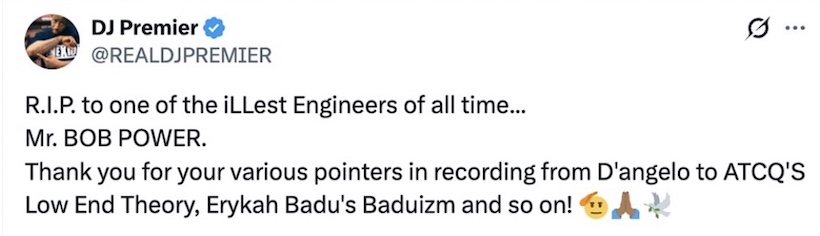
“R.I.P. to one of the iLLest Engineers of all time… Mr. BOB POWER. Thank you for your various pointers in recording from D’angelo to ATCQ’S Low End Theory, Erykah Badu’s Baduizm and so on,” said DJ Premier on Twitter (X).
Power’s name may not have always been front and center, but his sonic signature was unmistakable. He worked extensively with A Tribe Called Quest, helping craft the warm yet crisp sound that became a hallmark of their classic era. His work extended to The Roots, where live instrumentation and lyrical dexterity met careful engineering.
He also collaborated with soul innovators including D’Angelo, Erykah Badu and Common, helping sculpt albums that blurred genre lines and elevated Hip-Hop’s musicality. His reach stretched further to pioneers like De La Soul, Chaka Khan, Stetsasonic and Me’shell Ndegeocello.
Power’s contributions were not limited to turning knobs and aligning levels.
He was known for drawing out performances that felt organic yet polished. Artists often credited him with creating studio environments that encouraged experimentation without sacrificing clarity. In an era when sampling and live instrumentation were colliding in new ways, Power served as a bridge between analog warmth and digital precision.
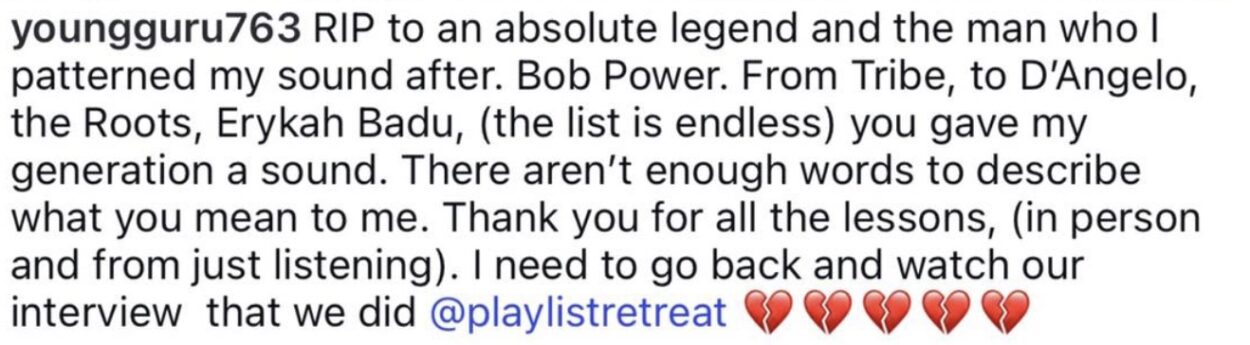
“RIP to an absolute legend and the man who I patterned my sound after. Bob Power. From Tribe, to D’Angelo, the Roots, Erykah Badu, (the list is endless) you gave my generation a sound,” said Jay-Z Engineeer Young Guru. “There aren’t enough words to describe what you mean to me. Thank you for all the lessons, (in person and from just listening).”
Beyond the boards, he was a respected educator, mentoring young musicians and engineers while teaching the craft with the same intensity he brought to the studio. Students remember him not just as an accomplished professional but as a patient guide who understood both the technical and emotional components of sound.
Power’s work delved into non-conventional music as well, including television and commercials.
As a composer for television, Power earned recognition for creating the theme to the Emmy Award–winning PBS program Over Easy. He also wrote the original theme and score for Disney’s family series The Scheme of Things. His additional television work included composing the theme and score for the prime time special Four Alone: The Older Woman in America, contributing to the National Endowment for the Humanities–funded project The State of the Language, and providing music for the Lifetime Channel and Disney’s Imagine.
In advertising, Power built an extensive portfolio, writing and producing music for major brands such as Coca-Cola, Philip Morris, Mercedes, Casio, Hertz, Jell-O, AT&T, Sprite, the U.S. Postal Service, Hasbro, Hardee’s, Duracell, Fritos, Ragu, A&W, Sharp Electronics and Intel. He also composed music for the American Cancer Society, a campaign that earned an Emmy Award, among numerous other clients.
But Power’s passing at 74 leaves a massive void in the Hip-Hop and R&B community.
The albums he helped shape remain staples in Hip-Hop and soul history and they will continue to be studied by producers and listeners alike.
Bob Power’s legacy lives not in the music and the impact on the generation that knew him and his work.


Breaking News
- Yaya Mayweather Ordered to Pay $50M to Woman Stabbed in NBA YoungBoy’s Home
- 50 Cent and Reebok Revive G-Unit Line With G6 Sneaker Release
- Mattel Honors Whitney Houston With New Barbie Doll You Can Now Buy
- Method Man Drops Limited-Edition Hat Collection with TWNTY-TWO and TICAL Athletics
- Ol’ Dirty Bastard Gets Brooklyn Street Renamed In His Honor
- Eminem’s Ex-Wife Tased During Arrest, Faces Seven Years In Prison For Biting Officer
- Nolan Wells’ Mother Demands Peace At Funeral While Seeking Answers
- Tory Lanez Announces Surprise Double Album While Still Behind Bars
- Eminem’s Ex-Wife Kim Scott Hospitalized After Suicide Attempt Two Months Post-DUI Arrest
- IShowSpeed & Burna Boy Set To Redefine Sports Entertainment At World Cup
